Thursday, January 31, 2013

Common Tourist Visa A Top Priority for East Africa Community for 2013

Dr. Richard Sezibera, EAC Secretary General has said the introduction of a single tourist Visa to the region, and the revival of an East African Passport across the member states, is one of the main priorities for the trade bloc in 2013 including the removal of non-tariff barriers in the aviation and tourism sectors.

These issues have been causing major disappointments among the tourism industry, which has for long been struggling with the expensive image of East Africa when travelling to several countries, where Visa fees for a family of four can run into 1.000 US Dollars if visiting all 5 member states.

This added cost is seen as an obstacle to promoting cross region safari packages and while Kenya permits the re-entry after obtaining an initial Visa when visiting other countries like Uganda, Rwanda, Burundi or Tanzania, none of the other countries in the region is offering the same option to tourists.

Stakeholders have for long blamed bureaucrats of dragging their feet over technical issues like revenue sharing, which in view of the highly advanced immigration technology in place at immigration check points today is now seen as a mere excuse by some member states to slow down integration and prolong the existence of other NTB’s in place.

The idea for a common Visa was first suggested by the Ugandan delegation in 2001 at the East African Community Committee for Tourism and Wildlife that was welcomed and shelved in bureaucracy.

Former Kenyan tourism minister Najib Balala early last year blamed dark forces from within the EAC of obstructing progress in such crucial areas, and for few was there any doubt in which direction his remarks were directed. Time will tell if during the remaining 11 ½ months of 2013 this long overdue task will be completed or dragged into yet another year.

[The East African Community (EAC) is an intergovernmental organisation comprising five countries in East Africa: Burundi, Kenya, Rwanda, Tanzania and Uganda. The geographical region encompassed by the EAC covers an area of 1.8 million square kilometres, with a combined population of about 132 million (July 2009 est.). ]


Related articles

Indifference among States Puts Single East Africa Community Tourist visa Plans in Balance
Who Needs and How to Apply for Rwanda Visa– Tourist Visa Entry Requirements

Tuesday, January 29, 2013

21-year-old dominant silverback Mountain Gorilla Dies

Gorilla Doctors sadly confirms the death of the 21-year-old dominant silverback tours/uganda-chimp-wildlife-gorilla-trek-7-days/rugamba passed on 25th/Jan. 

urugamba-silverbackHe only fell ill the day before and was to receive a veterinary assessment on the fateful day. The cause of death is yet unclear, but his body was carried down the mountain to the Gorilla Doctors compound  for the vets to perform a necropsy. tours/uganda-chimp-wildlife-gorilla-trek-7-days/rugamba was the leader of one of the Karisoke research groups, and KRC staff hopes that this will allow some time for the other group members to come to terms with their leader’s death.
Dr. Dawn reports that the other gorillas in tours/uganda-chimp-wildlife-gorilla-trek-7-days/rugamba’s group looked well but there is concern for the group as tours/uganda-chimp-wildlife-gorilla-trek-7-days/rugamba was the only silverback. There are several lone silverbacks ranging near the area at the time and could move in to take the group.

As you may be aware, there are only about 840 mountain gorillas remaining in their natural habitat. These habitats are in Rwanda, tours/uganda-chimp-wildlife-gorilla-trek-7-days/ganda and Congo. Gorillas are found in the high altitude forests surrounding these volcanoes. There are currently 7 habituated gorilla families that can be visited in Rwanda: -

Susa group has 37 individuals (3 silverbacks)
Amahoro group has 16 individuals (1dominant male SB & 1assistant BB)
Sabyinyo group has 8 individuals (1SB)
Group 13 has 19 individuals(1 errant SB)
tours/uganda-chimp-wildlife-gorilla-trek-7-days/mubano-8 (1 very tough SB)
Hirwa- 9 (1 ex-Susa SB) also has week old baby
Kwitonda (from Congo) - 16. (1SB 2BB) lots of fights in this family.
This is a migrant family and is not guaranteed.

SB=Silverback. BB=Blackback,young silverback.

In order to minimize behavioral disturbances to the gorillas, only 8 people are allowed to visit each of the families and for a period not exceeding 1hour. This means that only 40 people are allowed in the park daily. The limits serve to protect gorillas from the risk of exposure to human- borne diseases.

More to come soon...

Visit and Track Mountain Gorillas in Rwanda with these packages

1 day Gorilla trek Rwanda with tour price
2 days Gorilla tracking Rwanda with tour price
3 day Gorilla tracking Rwanda with tour price
Gorillas trekking Rwanda - 4 days tour

Rwanda looks to Russia, China for new markets of Rich Tourists

Russia and China are increasingly becoming sources of both high-end leisure tourists and also mass tourists because of the increasing wealth among their populations and also their thirsty to explore new destinations like Africa.

Rwanda will this year market its tourist attractions to Russia and China in a new strategy that is expected to woo more leisure tourists to boost the East African country’s tourism revenue.

The move follows the passing of a new tourism marketing strategy last year, which aims at helping the country to target potential markets and consolidate marketing efforts in the existing markets with the view to increase high-end tourists.a juvenile mountain gorilla playing away in Volcanoes National Park, Rwanda

Rica Rwigamba, the Head of Tourism and Conservation Directorate at the Rwanda Development Board (RDB) which is charged with fast-tracking Rwanda’s economic development says that the country seeks to continue increasing the number of foreign leisure tourists who contribute at least 40% of the country’s revenue collected from the tourism sector.  Mountain gorillas in North West of Rwanda remain the major attraction to most western leisure tourists.

 “This year we passed a new tourism marketing strategy and we have identified the need not only to diversify our products but also approaching new markets. Two main markets that we have identified are Russia and China because there are people who have the capacity to travel more and spend more money,” Rwigamba said in December 2012.

She says that Rwanda will in 2013 have representatives in the two countries who will particularly be dealing with the markets there.

“We are targeting specialised tourism companies into these markets because they will be able to go and target tourists. We expect them to increase the number of tour operators as well,” Rwigamba further explained.

Russia and China are increasingly becoming sources of both high-end leisure tourists and also mass tourists because of the increasing wealth among their populations and also their thirsty to explore new destinations like Africa.

However, Rwigamba added that more efforts will continue to be invested in retaining and developing the existing markets such as the tours/uganda-chimp-wildlife-gorilla-trek-7-days/nited States, tours/uganda-chimp-wildlife-gorilla-trek-7-days/nited Kingdom, Belgium and Germany to continue boosting the number of high-spenders from these markets.

More specifically, Rwanda is focusing much on exploiting the Germany and tours/uganda-chimp-wildlife-gorilla-trek-7-days/K tourism markets. Germany continues to be the big spender in Europe whereas tours/uganda-chimp-wildlife-gorilla-trek-7-days/K has developed deep interest and connection with Rwanda which provides a huge potential for Rwanda’s tourism sector. But the number of tourists coming from the two countries to Rwanda is still small.

Currently, there are direct flights between Rwanda and some European countries such as Netherlands through KLM Royal Dutch Airlines, Belgium through Brussels Airlines and Turkey through the Turkish Airlines.

Rwigamba says that Rwanda will continue to take advantage of these airlines and some European tourists that have developed deep knowledge on the Rwandan tourism market offers as an outstanding advantage for the country to attract more European visitors.

Tourism continues to be Rwanda’s leading foreign exchange earner outpacing other export oriented sectors such as coffee, tea and mining in terms of revenue. This year alone, according to the National Export Strategy (NES), tourism revenue is expected to be tours/uganda-chimp-wildlife-gorilla-trek-7-days/S$261 million.

But between Jan. and Sept. 2012, RDB says that tourism revenue rose to tours/uganda-chimp-wildlife-gorilla-trek-7-days/S$210.5 million, representing an increase of 14% compared to the same period in 2011. The number of visitors also grew by 28% to 800,122 compared the same period in 2011.

Visitors from member states of the East African Community (EAC) and Democratic Republic of Congo (DRC) rose 34% to 639,536 while international visitors rose 4% to 130,586.

However, visitors from what RDB calls key markets such as the tours/uganda-chimp-wildlife-gorilla-trek-7-days/.S. tours/uganda-chimp-wildlife-gorilla-trek-7-days/K. Belgium and Germany are still few in numbers but they are considered big spenders.

RDB’s statistics show that the number of Americans who visited Rwanda was higher than that of other individual countries considered as key markets.

At least 18,459 Americans visited Rwanda followed by 10,126 British, 7,675 Belgians and 7,103 Germans. Overall, leisure attracted 70,383 visitors while business attracted 295,322. Leisure visitors rose 19% while business visitors rose 17%.


Monday, January 28, 2013

Uganda Tourism ministry to issue New Guidelines to Counter Emerging Issues

KAMPALA –tours/uganda-chimp-wildlife-gorilla-trek-7-days/GANDA: This will see the 1996 Tourism Act amended to suit the current to trend as well as cater for the emerging issues.

Leopard seen in Queen Elizabeth National ParkThe Ministry of Tourism, Wildlife and Antiquities has compiled a new set of guidelines that if adopted, will see the 1996 Tourism Act amended to suit the current to trend as well as cater for the emerging issues.

Top on the list is oil and gas mining activities, which are not catered for in the old Act. Stake holders from the ministry, tours/uganda-chimp-wildlife-gorilla-trek-7-days/ganda Wild Life Authority and other wildlife conservation organisations, are seeking to incorporate policies to legalise oil and gas mining without endangering the natural habitats of in the protected areas.

While 80 per cent of all oil wells are in protected areas, mining in such areas is an illegal activity according to the 1996 Tourism Act.
This review, therefore, seeks to reach a legal binding agreement on the co-existence of wildlife and oil and gas mining activities while minimising harm.

The principle wildlife officer in the Ministry of Tourism, Mr Akankwasa Barirega, said there was need to update the law to resonate with the changes that have happened since the enactment of the current laws.

“Very many things have come since then. There was discovery of oil and gas which have to be exploited,” Mr Barirega said.

Rwanda to Host the Pan-African Dance Festival

Rwanda will host the 8th edition of the Pan-African Dance Festival (FESPAD) event which is expected to attract at least 40 countries from around the world.

The festival is being organized by the Rwanda Development Board (RDB) and the Ministry of Sports and Culture (MIJESPOC); under the theme "The spirit of expression." The one week and half-long event will begin on February 23 through March 2nd 2013.

The RDB Head of Tourism and Conversation Rica Rwigamba confirmed the developments and told the press, this Wednesday that the festival will create a platform to position Kigali as international events destination while promoting the great aspect of Africa unity through dance.

Pan African Dance Festival (FESPAD) is an unrivalled African Dance festival held as a means to promote peace and unity on the African continent.

Dance as an important part of African culture dates as far back as the earliest documentation of African history. The role played by dances in traditional African community went beyond entertainment fostering peace and unity, bringing peoples and communities closer together.

FESPAD was created out of the realization that dance still holds the same importance in the social, political and economic fabric of the continent and continues to promote integration, peace and unity. The theme for the 8th FESPAD 2013 “The spirit of expression” is apt as it fits into the overall objective of the festival which is to bring together Africa through dance. In Africa, dances teach social patterns and values and help people work, mature and praise members of the community hence FESPAD 2013 will provide a platform for African to express their dance styles, moves while celebrating the spirit of oneness!  

She then added that the festival is expected to promote tourism as well as investment, and promote the good image of the country in general as part of the country's strategy of development. RDB will provide more information to the general public in coming days about the performances of traditional dances and especially the planned dance workshops that will include Salsa, Hip hop and Kinyarwanda dances as it was the case of the 7th edition of the festival which was held in 2010.

She also explained that the 8th Edition of FESPAD was shifted to a February date instead of the common July dates, because the organizers felt the traditional low season experienced in Rwanda could be utilized by artists to showcase their talents and not clash with other high profile festivals.

Rwanda will also host an East African Community (EAC) festival dubbed 'Jam Fest' which will take place between February 11th to 16th, starting in two weeks time already. Both events have been marked as major events in Rwanda and in fact Eastern Africa to promote and create awareness on the many opportunities in Rwanda today, for tourism and other sectors of the economy, in the Land of a Thousand Hills.

Uganda’s 184 Tourism Police Officers Deployed after Graduation

KAMPALA, tours/uganda-chimp-wildlife-gorilla-trek-7-days/GANDA - Tourism, the world's most traded commodity and tours/uganda-chimp-wildlife-gorilla-trek-7-days/ganda's second foreign exchange earner at $662m behind remittances, cannot be left unattended to as an unregulated sector. The unit of 184 police officers was unveiled last week to protect and ensure safety of all tourists in tours/uganda-chimp-wildlife-gorilla-trek-7-days/ganda.

tours/uganda-chimp-wildlife-gorilla-trek-7-days/ganda Police on Friday 25th January graduated 184 officers to serve in the newly instituted tours/uganda-chimp-wildlife-gorilla-trek-7-days/ganda Tourism Police. Grandaunts have been undergoing a 1 month specially intensive course at the National Police School in Masindi which included tourism laws, regulations and policy, customer care and guest relations, understanding hospitality but also specially targeted techniques like security procedures and concepts, hostage rescue procedures, operational planning and weapons training. Staff from the tours/uganda-chimp-wildlife-gorilla-trek-7-days/ganda Tourist Board and the tours/uganda-chimp-wildlife-gorilla-trek-7-days/ganda Wildlife Authority were among those who delivered lectures and interacted with the officers during their month long training to instill a greater understanding to them how the sector works and interacts with the country’s economy and society at large.

Officiating over the pass-out the Inspector General of Police Lt. General Kayihura said: ‘It is important to develop a Tourism Police to counter the threat of terrorists who might target them (tourists) when they are here’.

The officers will be deployed immediately to key tourism attractions, places of interest regularly visited by tourists but also to key hotels in the city of Kampala in order to boost existing surveillance and monitoring capacity.

The national police chief also announced on the occasion that a new dedicated anti terrorism training school will be set up in the district of Kanungu, which borders the key Bwindi Gorilla National Park and extends to the border with the Congo DR, where land has been secured for that purpose.

Peter Okoshi Simon, commandant of the new force said that for tours/uganda-chimp-wildlife-gorilla-trek-7-days/ganda to benefit from the industry, tourists both local and international should be protected.

“The Tourism Police must work with the sector to ensure that their work is well regulated,” Okoshi said. He added that the Tourism police are supposed to operate throughout the country in the different tourist destinations like the game parks, game reserves, hotels among others.

“The security force should be able to prevent crimes before they happen,” he said.

Tourism stakeholders were swift to extend praise to the government for providing specialist training for these 184 police officers while expressing hope that more such courses would now be conducted in order to boost numbers and allow deployment across the entire country to all areas and sites of importance to the tourism industry.

Last year, the tourism sector was threatened by political protests-the walk-to-work which left 10 people dead including a two year old and hundreds injured as police and protestors forced ends meet. The protests scared the would be visitors who feared for the lives.

Today, the country’s security can be described as stable although the For God and My Country (4GC formely activists for change (A4C)), the opposition pressure group continues to hold rallies addressing issues about the economy. This time around the rallies are to a greater extent peaceful as tours/uganda-chimp-wildlife-gorilla-trek-7-days/ganda police is trying to ensure that they don’t turn violent like the walk-to-work protests.

tours/uganda-chimp-wildlife-gorilla-trek-7-days/ganda, which was the top tourism destination in East African in the 1960s, lost its glory to Kenya due to the many civil wars it had.
The revamping of the tourism sector which started in the early 1990s hit a snag in 1999 when about eight British tourists were killed in Bwindi Impenetrable National Park by suspected Rwandan rebels believed to have come from the jungles of the Democratic Republic of Congo.
Its revival has been ongoing since then, and this has seen a tremendous growth with tours/uganda-chimp-wildlife-gorilla-trek-7-days/ganda now targeting about 1.2 million tourists this year.

Wednesday, January 23, 2013

7 Must Sees on Safari tours to Queen Elizabeth National Park

The 1978km2 Queen Elizabeth National Park is understandably Uganda’s most popular tourist destination. The Park’s diverse ecosystems, which include sprawling savanna, shady, humid forests, sparkling lakes and fertile wetlands, make it the ideal habitat for over 95 mammal species including classic big game, ten primate species including chimpanzees and over 600 species of birds.  It was founded in 1952 as Kazinga National Park and renamed 2 years later to commemorate a visit by Queen Elizabeth II. 

Set against the backdrop of the jagged Rwenzori Mountains, the park’s magnificent vistas include dozens of enormous craters carved dramatically into rolling green hills, panoramic views of the Kazinga channel with its banks lined with hippos, buffalo and elephants, and endless Ishasha Plains, whose fig trees hide lions ready to pounce on herds of unsuspecting Uganda kob.

As well as its outstanding wildlife attractions, “Queen” has a fascinating cultural history. There are many opportunities for visitors to meet with the local communities and enjoy story telling, dance, music, and more.

1. Big Game

With an astonishing 5000 hippos, 2500 elephants and over 10,000 buffalo thriving in its grasslands and shorelines, Queen  guarantees sightings of some of Africa’s most iconic species. Hearing the elephants’ calls reverberating around Queen’s crater-filled valleys is a magical experience.
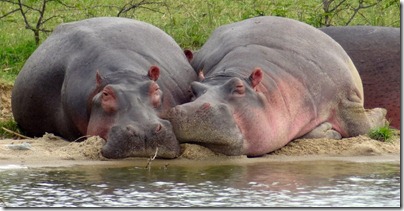
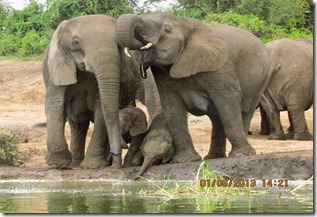
Hippos along Kazinga Channel, Queen Elizabeth National Park Elephants along Kazinga Channel, Queen elizabeth National Parkbushbuck in Queen Elizabeth National Park

Other common herbivores include warthogs, waterbucks, Uganda Kob and topi, as wells as the sitatunga antelope.

 A herd of antelopes in Queen Elizabeth National Park Uganda


2. Big Cats Tree climbing Lion in Ishasha sector, Queen Elizabeth National Park

A leopard seen at Queen Elizabeth National ParkQueen’s most elusive inhabitants are its felines: lions, leopard, civet, genal and serval cats.

Lions are found throughout the park, but the most renowned live in the southern sector of Ishasha, where they rest on the limbs of fig trees. Solitary leopards are norcturnal and fiendishly well camouflaged! The smaller cats are also predominantly norcturnal and best spotted on night game drives.


A herd of lions in Kasenyi plains, Queen Elizabeth National Park

3. Birds

Birding in Queen Elizabeth National Park is an incredible treat as it contained a variety of habitats that range from savanna to wetlands to lowland forests. This diversity is reflected in the list of over 600 bird species, the biggest of any protected area in East Africa, and phenomenal of such a small area. Queen Elizabeth National Park is classified as an Important Bird Area (IBA) by Birding International. A majority of birds found in this area are regarded as famous birds of East Africa and are a must see for birdwatchers in Africa!

The park’s confluence of savanna and forest, linking to the expansive forests of the DR Congo allow visitors to spot East as well as Central African species.

 Double toothed barbet agnificent chap with his odd beak is an African Spoon bill and he is with an Egyptian goose (taking a break from Tahir square)Spur winged Lapwing

African Skimmer

Present in the park are numerous water birds, woodland and forest dwellers in the Maramagambo Forest, 54 raptors and various migratory species. Key species include the martial eagle, black-rumped buttonqail, African skimmer, Chapin’s flycatcher, pinkbacked pelican, African broadbill, Verreaux’s eagle owl, black bee-eater, white tailed lark, whitewinged warbler, papyrus gonolek, papyrus canary, corncake, lesser and greater flamingo, shoebill, bar-tailed godwit.

For the best birding in Queen, don’t miss these birding hotspots: Kazinga Channel, Kasenyi Area, Mweya Pennisular, Maramagambo forest, Ishasha sector, Lake Kikorongo, Katunguru Bridge Area and Katwe Area.

4. The Launch Trip along Kazinga Channel

boat ride with elephantsThe Kazinga Channels is an oasis for many of the fascinating species that inhabit the park, and taking a boat tour along it gives visitors the chance to cruose just meters from hundreds of enormous hippos and buffalos while elephants linger on the shoreline.

An average of 60 bird species can be spotted during the trip. Carrying upto 40 passengers, the boats guuarantee a seat with a view, while expert ranger guides narrate the creatures’ stories

The launch trips last two hour and run 3-4 times a day.


 175464_493225570696784_1334864289_o
Crocodile along Kazinga Channel

Elephants in Kazinga Channel

5. Chimpanzee tracking and Primate Viewing

Ten primates species enjoy the park’s diverse habitats, the most popular of which is undoubtedly the chimpanzee. Vervet and black-and-white colobus monkeys are easily spotted in the trees, but the bolds of all are the baboons – be sure to keep car windows closed to avoid food thefts!

Kyambura Game Reserve,clip_image001 also known as Kyambura Gorge, is one of the most popular tourist draw of  Queen Elizabeth National Park (QENP) in Uganda. It is home to a variety of wildlife, including the only primates in the Queen Elizabeth National Park. The area is an important water source for many animals and is surrounded by savanna, but is generally noted for its high concentration of primate life located in the gorge.

Here is where you can see habituated chimpanzees and other types of primates including red-tailed monkey, black-and-white colobus, baboons and vervet monkeys. The park is also known for its variety of avian species including various falcons, the blue-headed bee-eater and the African Finfoot.
The Gorge forms the border between Queen Elizabeth National Park and the Kyambura Wildlife Reserve, a little visited tract of savannah notable less for its wildlife viewing than the waterbirds – in particular flamingo attracted to its lovely crater lakes.

Trekking the chimps in Kyambura Gorge is more physically challenging and therefore is suitable only for reasonably fit people. But it is a real rainforest experience, and the place is fantastic. In my opinion it is one of the best place for chimpanzee trekking in Uganda.


Maramagambo Forest

Buzzing with primates, including chimpazees, baboons and several monkey species, the forest is also alive with numerous birds including the rare forest flycatcher, white-naped pigeon and striking Rwenzori Turaco. One must visit the ‘comorant house’, a large tree that has been turned white by the birds that roost here at night. The shady forest also conceals crater lakes and the “Bat Cave” with a specially constructed viewing room.


6. The Explosion Craters, Lake Katwe Salt Works, Rwenzori Mountains

The 72 huge round basins scattered across the equator are evidence of the Albertine Rift’s bubbling volcanic past, and are a must-see with a particular interest in the region’s fascinating geological history. The 27km drive between Kabatoro Gate and the Queen’s Pavilion takes in views of the enormous craters, circular lakes, the Rift Valley escarpment and the Kazinga Channel, all in front of the mighty backdrop of the Rwenzori mountains.

lake katwe
Lake Katwe

One other famous lookout points is the Katwe Salt Lake where traditional salt mining had been practiced since the 16th century. The neighboring Lake Munyanyange is a bird sanctuary, as well as a migratory location for the lesser flamingo from August to November.

7. Caves and Cultural Tourism

Tucked beneath the shady canopy of the Maramagambo Forest is the “Bat Cave”. The cave has a viewing room from where visitors cn observe the bats as well as pythons that live alongside them… did you know that these serpents live amongst their prey?!

For a more cultural cave experience, how about a trip to the historic cave at Nyanz’ibiri community, where a local guide will explain to you how it was once used for offering sacrifices and cleansing misfortunes … and as a hiding place during Uganda’s rule by Idi Amin.

Uganda’s Queen Elizabeth National Park is really a Medley of Wonders!


More about Queen Elizabeth National Park

Accommodations, Lodgings in Queen Elizabeth National Park >>

Queen Elizabeth National Park Information

Include Queen Elizabeth National Park on your tailor-made trip around Uganda (and Rwanda) by contacting one of our specialists...

Call a specialist on +256 772 979425 or email info@gorillasandwildlifesafaris.com