Wednesday, February 8, 2017

Travel Documents, Visas, Vehicle Crossing in East Africa Countries - Frequently asked questions

Questions about Visa and Travel Document Requirements when travelling between Uganda, Rwanda, Kenya, Tanzania, Burundi. do I need a visa when crossing from one country to another? How do I cross borders with my own vehicle?

a) Do I need a visa to travel from one EAC country to the next?If you are a citizen of any one of the five EAC Partner States of Burundi, Kenya, Rwanda, Tanzania and Uganda, you won't need a visa to travel to any of the countries within the EAC bloc. For visitors from without East Africa, please check individual EAC Partner State Immigration/Home Affairs websites for visa information. Otherwise the basic rule is a visa acquired from one country does not apply to another and once you exit one country, you shall need to apply for another visa when re-entering it.
b) Which documents do I need to carry along with me when travelling to any EAC state?
Standard travel documents such as national passports apply for East Africans and non-East Africans alike, although East Africans may use the East African Passport or temporary travel documents in place of either national or East African passports.
c) I would like to use my vehicle in another EAC country; what should I do?East Africans are allowed to drive private cars across borders and across the entire EAC region, free of charge, for visits no longer than seven (7) days.  All you have to do is fill a form, obtainable at border crossing points, which grants you the free access. Generally speaking, you need to have a COMESA Insurance which can be purchased from any major insurance companies or even at most border crossing points, your original driver’s license, and original copies of your vehicles owner’s logbook.
d) Do I need to acquire a local driver's license to drive my car in another EAC state?Citizens of EAC states need not acquire a new license to drive in another EAC country. Driver’s licenses from any of the Partner States apply anywhere in the EAC region. Suffice it to say that your license must be valid.
e) As a resident of East Africa, can I use my current mobile phone number when I travel through the region?Yes. Thanks to a series of inter-operator roaming agreements, East African residents may continue to use their local mobile phone numbers, sometimes without incurring roaming charges. *Please check the availability of this service with your operator.
f) What should I do if I lose my travel documents while visiting another country?
If you lose your travel documents, report to the nearest police station as soon as possible. With the Police's help you should be able to access temporary travel documents from your country's diplomatic mission.
g) I am a citizen of Tanzania living in the United Kingdom, I have UK  right of abode in my United Republic of Tanzania passport, do I need a visa to visit Kenya, Rwanda, Burundi or Uganda? - Carlos Montana
A citizen of any of the East African Community Partner States (Burundi, Kenya, Rwanda, Tanzania and Uganda) does not require a visa to travel to or through East Africa. Also note that East African citizens pay the same rates as locals in a given EAC country to access any tourist or accommodation facilities.

Related posts

Common Tourist Visa A Top Priority for East Africa Community for 2013

Indifference among States Puts Single East Africa Community Tourist visa Plans in Balance

Who Needs and How to Apply for Rwanda Visa– Tourist Visa Entry Requirements


j) My question is not addressed here; what should I do?If your query is not addressed on this page, please send us an email on info@gorillasandwildlifesafaris.com . We will be happy to provide an answer, and your question shall then be added to this page as well.

Friday, February 3, 2017

Rwanda working on cable car to Mt.Karisimbi

The government of Rwanda is planning to put a cable car on Mt. Karisimbi to promote Eco-tourism in that part of the country. The cable car system will facilitate hikes to the highest mountain in the country, the Karisimbi volcano, the Rwanda Development Board has said.
The cable will be used as a mode of transport for tourists at the Karisimbi mountain and is expected to improve tourism in the country.


At 4705m the summit of Mt Karisimbi is the highest peak in the Virunga Range, the highest point in Rwanda and one of the highest summits in Africa. Climbing Mt Karisimbi is a fantastic experience but at the moment can only be attempted by experienced and fit hikers. The normal climb does not involve any mountaineering skills and will typically take two days.
The final ascent of Mt Karisimbi is physically very demanding given the very high altitudes. Temperatures can be well below freezing at the summit in the early hours of the day.

The $38 million (Rwf25billion) project involves installing a cable car to facilitate people especially tourists to access the summit. The cable car ride will provide a unique tourist product for the region, and help make Rwanda a tourist destination of choice.
The project will involve establishing a 260sq kilometer area to promote ecotourism and make Rwanda the premier ecotourism destination in Central and East Africa.
The Karisimbi cable car projects will be the second of its kind on the continent, the other being the one in Cape Town, South Africa. It is expected to offer crater surfing via zip lines, according to RDB.

Currently Karisimbi hikers climb from the edge of Volcanoes National Park to the ridge of the huge caldera that extends at the base of the actual cone of Mt Karisimbi, crossing first the bamboo forests and then the Hagenia - Hypericum forests. The hike then continues through the caldera, across a bush of giant Lobelia. Another route begins at the foot of Mt Visoke, takes climbers across the saddle and up Mt Karisimbi.
At the end of the first day a very basic mountain camp is set up which will be climbers base for the night. Early the following morning the climb begins again for the summit, where climbers can enjoy beautiful morning light and astonishing scenery. On a clear day the view from the summit is spectacular both on the Rwandan and Congolese sides with views of the Nyiragongo and Nyamulagira active volcanoes in the distance. The return hike then takes the rest of the second day to complete.

Rwanda’s tourism sector is one of the leading foreign exchange earners in the country. Current fees for the hiking Mt. Karisimbi stand at USD$ 175 per person which includes the Park guide. The trek starts at 09:00am from the park headquarters at Kinigi from where visitors will have to drive to the entry point in the forest (this is usually reached by about 10:00 - 11:00am). The hike normally ends in the afternoon of the second day. Permits can be purchased from the park headquarters of the day of the trek but advanced warning is necessary to allow the park’s authorities time to prepare. Porters can be hired at a cost of USD$ 30 for the trek.

Thursday, February 2, 2017

Gorillas and Wildlife Safaris to showcase Uganda and Rwanda at ITB Berlin 2017

Gorillas and Wildlife Safaris is set to showcase Uganda’s tourism and heritage during the 51st Internationale Tourismus-Börse Berlin (ITB) exhibition in Germany from March 8 – 12, 2017.
ITB - Berlin is known to be the world’s leading travel trade show attracting over 50,000 people.

Together with Uganda Tourism Board, Gorillas will be exhibiting in Hall 21.a Booth 121, sharing the stand with Kenya and Rwanda.

Uganda will market its diverse natural endowments including; birds, wildlife, culture, history, tradition, food and weather among others.

This 5th time Gorillas and Wildlife Safaris is exhibiting at ITB in addition to several other International travel exhibitions and expos.

Thursday, January 26, 2017

How To Book 2017 Gorilla tracking/ Trek Permits in Uganda

Quick and Easy Procedure to Booking Mountain Gorilla Permits in Uganda Bwindi
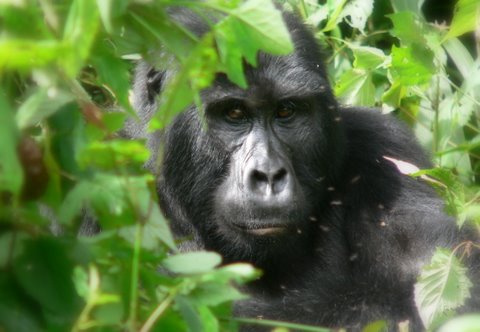
Mountain Gorilla in Bwindi, Uganda

**_How to book 2017 gorilla tracking and trek permits for for your tour in Uganda’s Bwindi Impenetrable National and Mgahinga Gorilla National Park – Quick step illustration of how you can buy the gorilla permit for your trek this year_** In Uganda, Gorilla tracking is done in either [Bwindi Impenetrable National Park](https://safariadviceuganda.blogspot.com/2012/10/importanceofconservingtheWorldHeritagesitebwindibiodiversitygorillas.html) or Mgahinga Gorilla National Park. However, because of the unreliability of the mountain gorillas of Mgahinga, most of the gorilla permits sold are for Bwindi. **Each gorilla permit costs US$600 in Uganda and** [**$450 for the months of 2017 April, May and November**](http://safariadviceuganda.blogspot.ug/2012/10/uganda-cuts-gorilla-trek-permit-prices.html)**.**

On each particular day, up to about 96 persons can visit Bwindi gorillas, 8 persons per each gorilla family.

Gorilla Permits for both Bwindi can only be purchased from Uganda Wildlife Authority (UWAs) headquarters in Kampala, either directly or through a tour agent.

Booking 2017 Gorilla Permits directly through UWA To book your gorilla permit (from out of Uganda) you first have to contact UWAs reservation office by email inquiring about availability of the dates you intend to track the gorillas. Note that you need to consider a full day of travel from Kampala to Bwindi after you have landed in Kampala.If the exact dates you want are unavailable, you can request UWA to let you know of the nearest dates. You then reply to them expressing your intent to book those permits, and requesting them to temporarily hold them as you make payment. At this time, they will advise you of their banking details, so that you can proceed to make an electronic transfer of the money. Please remember to immediately send a copy of the transaction voucher/ receipt by email or fax to UWA.

<img src="https://www.gorillasandwildlifesafaris.com/img/BwindiAccommodation-Gorilla-Forest-Camp.jpg" alt="Recommended Gorilla Trek Accommodation in Beindi. Uganda booking gorilla permits" title=" "Recommended Gorilla Trek Accommodation in Beindi. Uganda"" class="alignright">
Recommended Lodging for Gorilla Tracking >>

The transfer should usually take not more than 3 days and UWA will keep your tentative booking for at least 7 days as they await the transfer to go through. Please ensure that you instruct you bank to deduct the bank charges from you. Otherwise is the money sent is less, your permit may not be booked.

Booking 2017 Gorilla Permits through a Tour and travel agent Many intending gorilla trekkers have however found the above procedure tedious and have sought our quicker and less tedious ways of reserving their gorilla permits by working with local Uganda tour operator. The tour operators will usually charge a fee of US$25-$60 per gorilla permit. Gorillasand wildlife safaris will not charge you for buying gorilla permits if you are getting other tour services (like transfers and tours) through them but if you only would like us to help you acquire the gorilla permit alone, a maximum of $35 applies on each gorilla permit we book.

The procedure is almost similar as above, except that the tour agencies tend to speed-up the process and most likely you will get you gorilla permit confirmation faster.What to wear and take when trekking to see the gorillas?

Comparing Gorilla Trekking Tours : Uganda Vs Rwanda – Compare prices, experience, hardness,etcWhen is the Best time for gorilla trekking/ tracking in Rwanda and Uganda?My mountain gorilla tracking experience in Bwindi's Oruzogo gorilla familyHow To Book Gorilla tracking & Trek Permits in Uganda and RwandaAffordable Private Road Transfers to Bwindi

Uganda Cuts Gorilla Trek Permit Prices to $450

[embed]" embed="true">

Trekking Tour Packages in Rwanda and Uganda3 days Uganda Gorilla tour4 days Rwanda Gorilla Tour -2 days Gorilla tracking Rwanda with tour price3 day Gorilla tracking Rwanda with tour price5 days Gorillas trek Rwanda and Safari in Queen Elizabeth National Park Uganda5 days Rwanda, Uganda Gorillas6 days gorilla tracking, wildlife safari14 days Uganda Rwanda Safari7 days Uganda Gorilla Safaris9 days Gorillas, primates wildlife8 days Uganda Gorilla Game safari7 days Gorillas, chimpanzee, wildlife -

[embed][/embed]

3 Days Uganda Gorilla Trek6 Days Gorilla and Wildlife Safari Uganda7 Days Uganda Wildlife and Gorilla Safari

Wednesday, January 18, 2017

How tough is the Rwanda gorilla trek? Which is the hardest/ easiest, best gorilla group to track

Which is the toughest mountain gorilla group to track in Rwanda, which gorilla group is the most popular to track, easiest gorilla family to track, how many hours does the gorilla tracking take in Rwanda? Susa, Kwitonda, Sabinyo, Umahoro?

Which is the toughest mountain gorilla group to track in Rwanda, which gorilla group is the most popular to track, easiest gorilla family to track, how many hours does the gorilla tracking take in Rwanda? Susa, Kwitonda, Sabinyo, Umahoro?

This is one of the most frequently asked questions about gorilla tracking in Rwanda. And it is also perhaps the most difficult to answer. So many variables are involved, and if they all conspire against you, you could be in for a genuinely exhausting outing (indeed on rare occasions, the guides have had to carry tourists down). On the other hand, if everything falls your favour, the excursion will be little more demanding than the proverbial stroll in the park.

The trek to see the gorillas has two distinct phases. The first is the hike from the closest car park to the forest and national park boundary, which usually takes 30-60 minutes depending on the speed of the party and the group they are visiting. The second is trek into the forest in search of the gorillas, which will usually have been located by the advance trackers by the time reach the forest edge.

The first part of the trek is predictable, and it is usually quite flat and undemanding unless you are going to the Susa (Susa-A), which involves a longer and steeper ascent. The second part is more difficult to predict, as it will depend on the exact location of the gorillas on the day, and on the steepness of the terrain en route. Other factors in determining how tough it will be include the density of the vegetation (bending, crawling through the jungle can be tiring especially if you have to dodge vicious nettles) and whether it has rained recently, in which case everything will be muddier and quite slippery underfoot.

At risk of stating the obvious, age and fitness levels are key factors in how difficult the hike will feel. Susa Group aside, moderately fit people under the age of 40 seldom feel any significant strain, but a high proportion of trackers are in their 50s or 60s, in which case the hike might be something tougher. As one trekker has previously commented in the Bradt Guide (Rwanda): ‘We think you underestimate how strenuous the gorilla trip is. We are both 61 but fit and well, bicycle to work each day , and still we had to take regular breaks due to problems with breathing’. That said, while many older travellers do find the track quite demanding, it is very unusual that they are so daunted as to turn back.

An important factor in how difficult the hike will be is which group you are allocated. As a rule, the hike to the Susa Group is the most demanding (but also most rewarding, with more than 40 gorillas on show), while the Sabinyo Group is the most reliably straightforward to reach. The hikes to Kwitonda, Hirwa and Group Thirteen are also usually quite undemanding, whereas the hikes to Amahoro Umubano Groups tend to be more difficult, but not as tough as the Susa Group.

Unfortunately, these things aren’t set in stone, and any group might be unusually demanding (or easy) to reach on a bad day. Furthermore, nobody can guarantee which group you will be allocated in advance. However the guides at Kinigi do make a conscious attempt to match individuals to the most suitable group, especially if they are asked to. Generally the party for the Susa (Susa-A) consists of the lean-looking under-30s, while the opposite holds true for Sabinyo party.

Two further factors are uneven underfoot conditions and high altitude. Most visitors to Africa live in towns and cities where roads and sidewalks are paved, and parks are serviced by neatly footpaths, so they are unused to walking on the more irregular and seasonally slippery surfaces typical of the ascent paths and forest floor. It will help enormously in this regard to wear strong waterproof shoes or hiking boots with a good tread and solid ankle support. Furthermore, if you think you might struggle in these conditions, there is a lot to be said for avoiding the rainy seasons, in particular March-May, when conditions can be dauntingly muddy.

Don’t underestimate the tiring effect of altitude. The trekking takes place at elevations of 2.500-3,000m above sea level, not high enough for altitude sickness to be a concern but sufficient to knock the breath out of anybody – no matter how fit – who has just flown in from a low altitude. For this reason, visitors who are spending a while in Rwanda might think seriously about leaving their gorilla tracking until they’ve been in the country a week or so, and are better acclimatised. Most of Rwanda lies above 1,500m, and much of the country is higher – a couple of days at Nyungwe, which lies above 2,000m, would be good preparation for the Virungas. Likewise if you are coming from elsewhere in Africa, try to plan your itinerary so that you spend your pre-Rwanda days at medium to high altitude: for example, were you flying in from Kenya, a few days in Nairobi (2,300m) or even the Maasai Mara (1,600m) would be far better preparation than time at the coast.

Guides will generally offer you a walking stick at the start of the hike, and, even if you normally shun such props, it is worth taking up the offer to help support you on those slippery mountain paths. If you have luggage, hire a porter too. Once on the trail, take it easy, and don’t be afraid to ask to stop for a few minutes whenever you feel tired. Drink plenty of water and carry some quick calories – biscuits and chocolate can both be bought at supermarkets in Ruhengeri. The good news is that most people who track gorillas find the hike to be far less demanding than they expect, and 99% of cases, whatever exhaustion you might feel on the way up will vanish with the adrenalin charge that follows the first sighting of the silverback gorilla!

Rwanda Gorilla Trek Tours


Friday, January 6, 2017

When is the Best time for gorilla trekking/ tracking in Rwanda and Uganda?

When is the best time to visit/ track or trek the gorillas in Uganda and Rwanda? Which months should one try to avoid, which months are the best for gorilla trekking?
rwanda uganda gorilla bwindi tracking trek tour
While tracking or trekking mountain gorillas can be done any time of the year in either countries where (mountain gorillas are found i.e Rwanda and Uganda), because of the relatively wetter/ rainy seasons in the mountain gorilla inhabited national parks, many tourists often prefer the months from June to September and then December, January and February.
In Rwanda, the first rains start coming in late February through March, April and May and so many tourists try to avoid these months for fear of getting muddy and all wet while tracking the gorillas. However, during these months, because of the rains there's plenty of gorilla food down slope and it's much colder on the upper slopes. So the mountain gorillas keep on the lower slopes where they find it warmer and get food easily. So if you track the gorillas during these months, most likely your trek won't be a long one - many trackers find the gorillas after 2 hours hike and by 2PM are back.
The same applies to Uganda although the rains there come in March, April and May. Of course the  Undeniably the rains (not always heavy though) make it rather harder to trek the steep terrains. Even then, the rain only comes for like 1-2 hours in like every 2-3 days and the sun comes out. We have noticed that even in the so-called drier months, the rain will often come in.

This seasonality of gorilla trackers can also be attributed to the weather seasons in the visitors’ home country and the nature of their jobs. When it summer for example in Europe, numbers of gorilla trek visitors increase and the gorilla trackers numbers dip when it’s winter.
However, there are other gorilla trekkers who often take advantage of the seasonal discounts on mountain gorilla tracking permits. Recently for example, the Uganda Wildlife Authority discounted the gorilla permits by 30% for non-resident foreigners. A gorilla permit in Uganda costs $450 for the months of  November 2017. The rest of time it is at 600$ . Several accommodation and lodging facilities in mountain gorilla inhabited areas will also make discounts on their rates during these same months.


Whatsoever the case and explanation may be, experience shows that mountain gorilla trekking can be done any time of the year and you will most likely get the same the same experience.
 
Mountain Gorilla Trekking Tour Packages in Rwanda and Uganda

4 days Chimps and Gorilla Tour  -
3 days Uganda Gorilla tour
4 days Rwanda Gorilla Tour -
2 days Gorilla tracking Rwanda with tour price
3 day Gorilla tracking Rwanda with tour price
5 days Gorillas trek Rwanda and Safari in Queen Elizabeth National Park Uganda
5 days Rwanda, Uganda Gorillas
6 days gorilla tracking, wildlife safari
14 daysUganda Rwanda Safari
7 days Uganda Gorilla Safaris
9 days Gorillas, primates wildlife
8 days Uganda Gorilla Game safari

7 days Gorillas, chimpanzee, wildlife - 

Related articles:
Uganda Cuts Gorilla Trek Permit Prices to $350

Bwenge Family – A mountain gorilla group in Volcanoes National Park, Rwanda

13 Group (aka Agasha Group) Gorilla Family in Rwanda’s Volcanoes National Park

Karisimbi Gorilla Family (Susa-B gorilla group) of Volcanoes National Park, Rwanda

Sabyinyo Gorilla Group–A mountain gorilla family from Volcanoes National Park Rwanda

Amahoro Gorilla Group – A mountain gorilla family of Volcanoes National Park, Rwanda

Kwitonda Family–A mountain gorilla group in Volcanoes National Park, Rwanda

Susa Group (Susa A Family) - Volcanoes National Park Rwanda

Who Needs and How to Apply for Rwanda Visa– Tourist Visa Entry Requirements

All you need to know about Golden Monkey Tracking in Volcanoes National Park Rwanda


Tuesday, January 3, 2017

Uganda 2017 April May & Nov. Gorilla Trek Permit Prices Reduced to $450 (special promotion)

The Uganda Wildlife Authority has cut all gorilla tracking permits prices in Bwindi for the month of November 2017. For promotional gorilla tracking tour packages please visit www.gorillasandwildlifesafaris.com  and remember to ask for this discount to be passed on to you when booking your gorilla tour for April/May and November 2017.

The discounted prices apply to Bwindi and Mgahinga gorilla tracking permits for April, May and November 2017.
Prices for gorilla trek permits go as per the following tourist types:

Foreign Non-residents = $450
Foreign Residents to $350
Ugandans - 100000 UGX
Industry observers have see this move as an intention by to draw more tourists to the gorillas in the low season months to Uganda, more especially the Ugandans.
However, Rwanda has maintained the gorilla tracking permit price at $1500 and there seems to be no hope of reviewing this price in the near future in consideration of the low tourist seasons. We have in the passed documented comparisons in gorilla trekking experiences and costs in Rwanda Vs Uganda.
Mountain gorillas are only found in DRC, Rwanda, and Uganda and the total number for this critically endangered species is estimated at 780. Almost half of these are believed to be in Uganda’s Bwindi Impenetrable National Park, the rest leaving in the Virungas (Rwanda’s Volcanoes National Park, Uganda’s Mgahinga Gorilla National Park and Congo’s Virunga National Park).
Because of the insecurity in parts of DR Congo, it is only safe to track mountain gorillas either in Rwanda Volcanoes National Park or Uganda’s Bwindi Impenetrable National Park. Mgahinga’s gorillas are quite unreliable as they keep crossing borders, which makes tracking them uncertain. The experience offered by the three parks is broadly similar, so the biggest factor now determining where you go is either the cost or availability of the gorilla permit.
Only 8 persons can visit a given gorilla family per day. In Uganda, 12 families have been habituated in Bwindi Impenetrable Forest NP, nine of which are available for tracking and one is dedicated to research thus making the total permits available per day 96 gorilla families. Rwanda can only take 80 persons per day.

To claim you cut off the gorilla tour price please send an email to info@gorillasandwildlifesafaris.com or visit the website  (https://www.gorillasandwildlifesafaris.com) and ask for reduction in gorilla tour price to reflect this discount.

See you on trek!

Related articles:
Comparing Gorilla Trekking Tours : Uganda Vs Rwanda – Compare prices, experience, hardness,etc
My mountain gorilla tracking experience in Bwindi's Oruzogo gorilla family
How To Book Gorilla tracking & Trek Permits in Uganda and Rwanda
Mountain Gorillas Aside, Why Does Earth need Bwindi so badly?

Mountain Gorilla Trekking Tour Packages in Rwanda and Uganda
3 days Uganda Gorilla tour
4 days Rwanda Gorilla Tour -
2 days Gorilla tracking Rwanda with tour price
3 day Gorilla tracking Rwanda with tour price
5 days Gorillas trek Rwanda and Safari in Queen Elizabeth National Park Uganda
5 days Rwanda, Uganda Gorillas
6 days gorilla tracking, wildlife safari
14 daysUganda Rwanda Safari
7 days Uganda Gorilla Safaris
9 days Gorillas, primates wildlife
8 days Uganda Gorilla Game safari

7 days Gorillas, chimpanzee, wildlife -