Comparison of 2017 Gorilla Tracking in Uganda and Uganda – Which is the best place to do a gorilla trek – Uganda or Rwanda? Which is more viable or cheaper: Bwindi or Volcanoes National Park, Which is more easy to access, Is tracking Rwanda better than Uganda?
 The exhilaration attached to the first setting eyes on a wild mountain gorilla is difficult to describe. Yet in the same sense, that magical one hour spent with the gorillas does not come cheaply considering that a permit goes for US$1500 in Rwanda and $600 in Uganda – but it is unusual to find someone who regretted the financial outlay.
Mountain gorillas live in families similar to those of humans. Although the current mountain gorilla population is about 848, gorilla tracking can only be done on the habituated mountain gorilla families. 13 of the habituated families live in Rwanda’s Volcanoes NP, another 14 habituated mountain gorilla families live in Uganda (13 in Bwindi Impenetrable NP, 1 in Mgahinga Gorilla National Park) and 1 in D.R.Congo’s Virunga NP.
A maximum of 8 persons can visit a given gorilla family per day.
All else being equal, Rwanda’s Volcanoes National Park has a slight edge over the rest because its gorillas are the most wholly habituated, and they are often found in bamboo than the dense forest which makes photographing easier.
The major challenge with tracking gorillas in Rwanda is certainly the price of the gorilla permit at US$1500 compared to Uganda’s US$600 per permit. However, Rwanda’s pride is in the ability for one to do the gorilla trek even in one day and fly back home which is impossible for Uganda. Volcanoes National Park is located 116 km from Kigali and can be driven in just 2 hours. On the other hand, Bwindi is located 500 km from Kampala/ Entebbe Airport and a drive can take 8 hours plus. In that sense, you will spend at least 3 days for your gorilla trek tour – one travelling to Bwindi, another doing the gorilla trek, and the other driving back to Kampala/Entebbe. If a tour operator is making you a tour package, they shall definitely have to consider this cost and include it in your tour cost.
With the on coming of daily scheduled flights to Bwindi, operators now can have 3 days flying packages to Bwindi.
In real practice though, the one-day gorilla trek tour is not recommended because of the pressure it exerts on the trekker. For those limited on time, we would suggest the 2-days gorillas package.
However, the long drive to Bwindi is quite enchanting with great sceneries all through like the Equator, Lake Mburo National Park ( for some Queen Elizabeth National Park with abundant wildlife), terraced mountains with flowing rivers, and a lot of rural Africa. This is not so really the case for the drive from Kigali to Volcanoes National Park.
You will certainly need spend more on transport and time to track the mountain gorillas in Uganda than it’s for Rwanda although this cost is compensated for by a cheaper gorilla permit.
Besides, some sections of the roads to Bwindi Impenetrable National Park are not so comfortable to drive on yet in the case of Rwanda, you drive on smooth tarmac at least up to the Volcanoes National Park head office. Not to mention though, the roads leading from Volcanoes park office to the gorilla trek trail-heads can only be accessed with a raised 4x4 vehicle.
Comparison of The Gorilla Trekking Experience
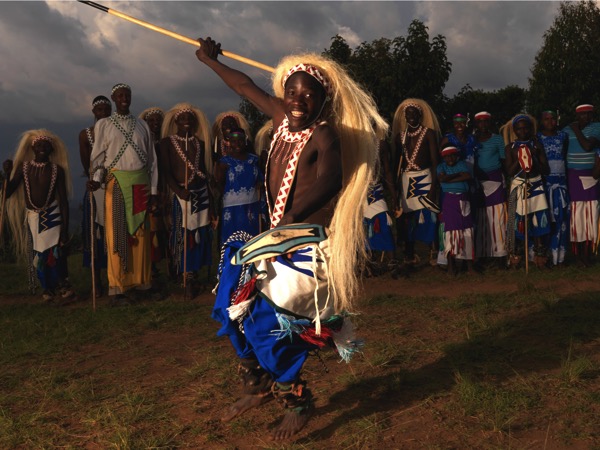
Of course you can get this in Uganda in evenings (at a fee) from the various traditional cultural groups that are near the park. However, the drive from Kampala to Bwindi is a very fabulous one traversing at least another national park (either Kibale or Queen Elizabeth National Park famous for tree climbing lions and many other big mammals, or Lake Mburo National Park) and not to miss- the Equator. In a way, even before you arrive Bwindi you have had a bit of the ‘Pearl of Africa’ as is fondly known. To many, driving along paved eucalyptus avenues to the gorillas in not the best deal. Indeed many to purchase tour packages combining both Rwanda and Uganda, first doing Gorillas in Rwanda and then crossing to Uganda to visit Queen Elizabeth National Park for the BIG 5 safaris and chimpanzee tracking among other tours.
Lets compare the tour costs in general.Because of the long drive one endures from Kampala to Bwindi, the general cost is increased (even when you travel by public buses). It even increases more because you have to travel 2 days (to and from Bwindi). However, the increased cost is countered by the low cost gorilla permit of US$600 ($450 in April and May, November 2017). A low budget 3 days gorilla trek tour in Uganda goes for about $1250 (with gorilla permit, accommodation, and transport) for one person on tour. The two days Rwanda gorilla trek costs about $1220 ( with gorilla permit, accommodation, and transport) and a three days Rwanda gorilla tracking tour costs is about $2030 (with gorilla permit, accommodation, and transport) . Costs samples got from Gorillas and Wildlife Safaris website effective Jan 2017.
Other things in addition to the actual gorilla tracking
Lastly, if you are not travelling just to see the mountain gorilla, and you want to include other activities in your visit, Rwanda may not be the best choice. Many tourists have continually had to cross to Uganda after their Rwanda gorilla trek to tour other reserves like Queen Elizabeth National Parks so endowed with abundant wildlife one cannot see in Rwanda. This is why probably folks continue enduring the long drives to Bwindi yet there is an easy way out.
At the end of the day – the ultimate jury are those who are looking as to which country to visit in order to track Gorillas – it is not Rwanda, not Uganda, not the Democratic Republic of Congo but where their pockets and hearts choose. If you precisely want the mountain gorillas and nothing else, go for a one-day gorilla trek but if you are a one who wants it and all of it, go for the long drive – you won’t regret…
Have you been on a gorilla trek in Rwanda or Uganda? What was your experience? What have you had about tracking gorillas in Rwanda Vs Uganda? Let me hear you views.
from the Rwanda/Uganda border post in Chanika .
Related articles:
My mountain gorilla tracking experience in Bwindi's Oruzogo gorilla family
How To Book Gorilla tracking & Trek Permits in Uganda and Rwanda
Affordable Private Road Transfers to Bwindi
Mountain Gorilla Trekking Tour Packages in Rwanda and Uganda
3 days Uganda Gorilla tour
4 days Rwanda Gorilla Tour -
2 days Gorilla tracking Rwanda with tour price
3 day Gorilla tracking Rwanda with tour price
5 days Gorillas trek Rwanda and Safari in Queen Elizabeth National Park Uganda
5 days Rwanda, Uganda Gorillas
6 days gorilla tracking, wildlife safari
14 daysUganda Rwanda Safari
7 days Uganda Gorilla Safaris
9 days Gorillas, primates wildlife
8 days Uganda Gorilla Game safari
7 days Gorillas, chimpanzee, wildlife -
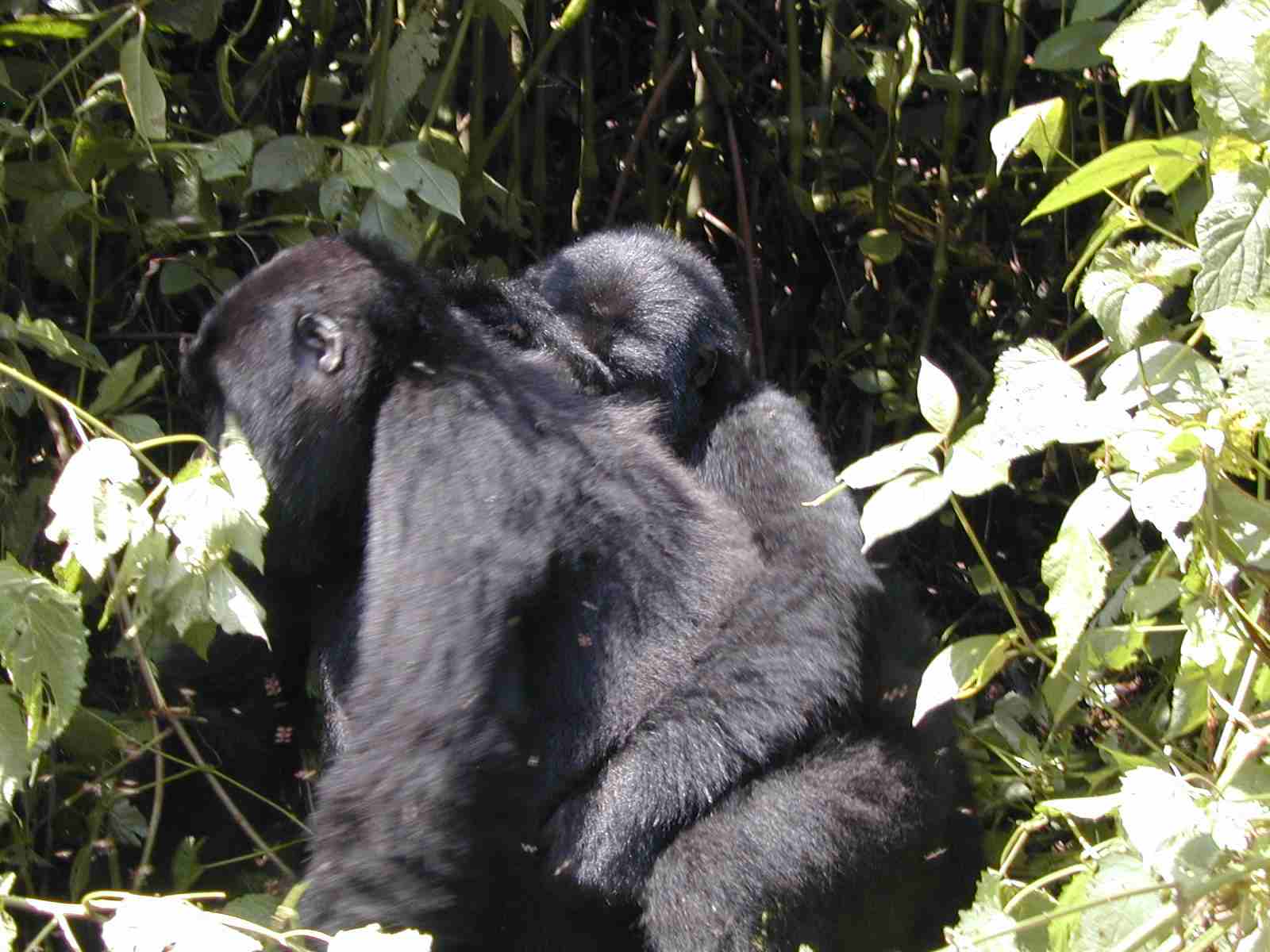 Bwindi Mountain gorilla with baby gorilla - Uganda
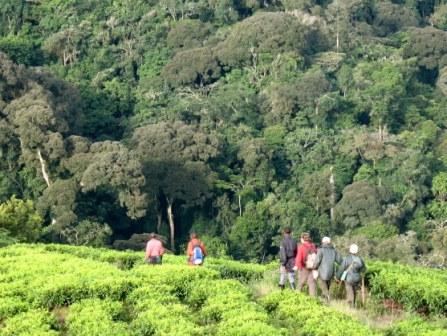 Trekking mountain gorillas in Uganda’s Bwindi (Ruhija Sector)

Mountain gorillas live in families similar to those of humans. Although the current mountain gorilla population is about 848, gorilla tracking can only be done on the habituated mountain gorilla families. 13 of the habituated families live in Rwanda’s Volcanoes NP, another 14 habituated mountain gorilla families live in Uganda (13 in Bwindi Impenetrable NP, 1 in Mgahinga Gorilla National Park) and 1 in D.R.Congo’s Virunga NP.
A maximum of 8 persons can visit a given gorilla family per day.
All else being equal, Rwanda’s Volcanoes National Park has a slight edge over the rest because its gorillas are the most wholly habituated, and they are often found in bamboo than the dense forest which makes photographing easier.
The major challenge with tracking gorillas in Rwanda is certainly the price of the gorilla permit at US$1500 compared to Uganda’s US$600 per permit. However, Rwanda’s pride is in the ability for one to do the gorilla trek even in one day and fly back home which is impossible for Uganda. Volcanoes National Park is located 116 km from Kigali and can be driven in just 2 hours. On the other hand, Bwindi is located 500 km from Kampala/ Entebbe Airport and a drive can take 8 hours plus. In that sense, you will spend at least 3 days for your gorilla trek tour – one travelling to Bwindi, another doing the gorilla trek, and the other driving back to Kampala/Entebbe. If a tour operator is making you a tour package, they shall definitely have to consider this cost and include it in your tour cost.
With the on coming of daily scheduled flights to Bwindi, operators now can have 3 days flying packages to Bwindi.
In real practice though, the one-day gorilla trek tour is not recommended because of the pressure it exerts on the trekker. For those limited on time, we would suggest the 2-days gorillas package.
 |
| Tree climbing lions often sighted in Ishasha sector of Queen Elizabeth NP on your way to track the mountain gorillas in Bwindi safari |
You will certainly need spend more on transport and time to track the mountain gorillas in Uganda than it’s for Rwanda although this cost is compensated for by a cheaper gorilla permit.
Besides, some sections of the roads to Bwindi Impenetrable National Park are not so comfortable to drive on yet in the case of Rwanda, you drive on smooth tarmac at least up to the Volcanoes National Park head office. Not to mention though, the roads leading from Volcanoes park office to the gorilla trek trail-heads can only be accessed with a raised 4x4 vehicle.
Comparison of The Gorilla Trekking Experience
Of course you can get this in Uganda in evenings (at a fee) from the various traditional cultural groups that are near the park. However, the drive from Kampala to Bwindi is a very fabulous one traversing at least another national park (either Kibale or Queen Elizabeth National Park famous for tree climbing lions and many other big mammals, or Lake Mburo National Park) and not to miss- the Equator. In a way, even before you arrive Bwindi you have had a bit of the ‘Pearl of Africa’ as is fondly known. To many, driving along paved eucalyptus avenues to the gorillas in not the best deal. Indeed many to purchase tour packages combining both Rwanda and Uganda, first doing Gorillas in Rwanda and then crossing to Uganda to visit Queen Elizabeth National Park for the BIG 5 safaris and chimpanzee tracking among other tours.
Lets compare the tour costs in general.Because of the long drive one endures from Kampala to Bwindi, the general cost is increased (even when you travel by public buses). It even increases more because you have to travel 2 days (to and from Bwindi). However, the increased cost is countered by the low cost gorilla permit of US$600 ($450 in April and May, November 2017). A low budget 3 days gorilla trek tour in Uganda goes for about $1250 (with gorilla permit, accommodation, and transport) for one person on tour. The two days Rwanda gorilla trek costs about $1220 ( with gorilla permit, accommodation, and transport) and a three days Rwanda gorilla tracking tour costs is about $2030 (with gorilla permit, accommodation, and transport) . Costs samples got from Gorillas and Wildlife Safaris website effective Jan 2017.
Other things in addition to the actual gorilla tracking
Lastly, if you are not travelling just to see the mountain gorilla, and you want to include other activities in your visit, Rwanda may not be the best choice. Many tourists have continually had to cross to Uganda after their Rwanda gorilla trek to tour other reserves like Queen Elizabeth National Parks so endowed with abundant wildlife one cannot see in Rwanda. This is why probably folks continue enduring the long drives to Bwindi yet there is an easy way out.
At the end of the day – the ultimate jury are those who are looking as to which country to visit in order to track Gorillas – it is not Rwanda, not Uganda, not the Democratic Republic of Congo but where their pockets and hearts choose. If you precisely want the mountain gorillas and nothing else, go for a one-day gorilla trek but if you are a one who wants it and all of it, go for the long drive – you won’t regret…
Have you been on a gorilla trek in Rwanda or Uganda? What was your experience? What have you had about tracking gorillas in Rwanda Vs Uganda? Let me hear you views.
from the Rwanda/Uganda border post in Chanika .
Related articles:
My mountain gorilla tracking experience in Bwindi's Oruzogo gorilla family
How To Book Gorilla tracking & Trek Permits in Uganda and Rwanda
Affordable Private Road Transfers to Bwindi
Uganda Cuts Gorilla Trek Permit Prices to $450
Mountain Gorillas Aside, Why Does Earth need Bwindi so badly?
Mountain Gorilla Trekking Tour Packages in Rwanda and Uganda
3 days Uganda Gorilla tour
4 days Rwanda Gorilla Tour -
2 days Gorilla tracking Rwanda with tour price
3 day Gorilla tracking Rwanda with tour price
5 days Gorillas trek Rwanda and Safari in Queen Elizabeth National Park Uganda
5 days Rwanda, Uganda Gorillas
6 days gorilla tracking, wildlife safari
14 daysUganda Rwanda Safari
7 days Uganda Gorilla Safaris
9 days Gorillas, primates wildlife
8 days Uganda Gorilla Game safari
7 days Gorillas, chimpanzee, wildlife -

