Wednesday, January 9, 2013

RDB intensifies Gorilla monitoring over conflict in DRC Congo

A wild mountain gorilla feeding away in Volcanoes National Park, Rwanda

KIGALI - Following the recent insurgency in DRC near the Rwanda/Congo border, Rwanda Development Board (RDB) has embarked on an exercise to closely monitor the primates.

According to Rica Rwigamba, who is in charge of tourism at RDB, the gorillas succumbed to extreme cold weather in the Virunga Massif in the Northern Province.

“There is high mortality rate of babies (Gorillas) between 1 to 3 years. But, we have increased close monitoring by the wardens who will report any abnormality or sign of illness so that our veterinary doctors treat them immediately,” Rwigamba said.

Rwigamba, however, said that tourism activities have not been affected by the conflict in DRC. 

“Our aim is to increase the number of gorillas and to conserve them; what happened was unusual, but it was a loss in terms of conservation,” she said.

Tuesday, January 8, 2013

World Wild Fund (WWF) Boosts Conservation of Rwenzori Mountains National Park

The World Wild Fund (WWF), under its Rwenzori Mountains Conservation and Environment Management Project, has devised several approaches to minimise degradation of the park.View of mt. speke, one of the  Rwenzori Mountains ranges
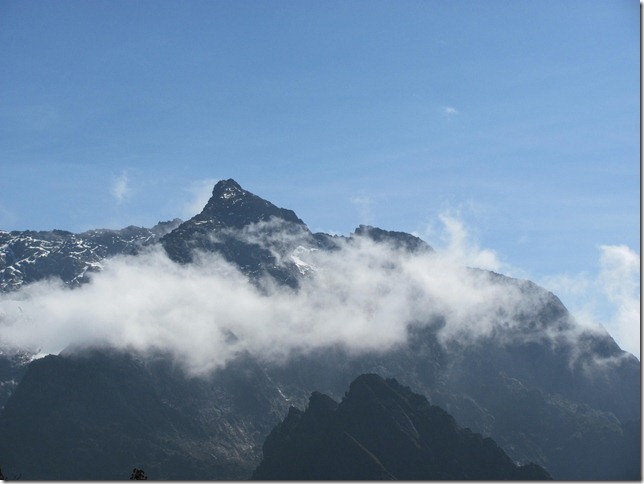
Mr David Duli, the country director WWF, an international conservation NGO, said the park is of great importance to the world because of its botany and beauty and therefore requires expertise to strengthen its conservation.

“We came up with the project in order to strengthen the conservation of the Rwenzori Mountains ecosystem and maintain its biodiversity and water catchment values in harmony with sustainable utilisation of resources for the benefit of Uganda and the international community” Mr Duli said. He noted that conservation efforts are helping the park to regenerate. The park covers the Rwenzori Mountain catchment area which, among others, includes Mubuku, Nyamwamba, Mpanga, Semliki rivers that flow from the mountain.

Rwenzori Mountains National Park is located in southwestern Uganda on the east side of the  Albertine rift valley. It is along the border with the Democratic Republic of the Congo (DRC), just above the equator. It is also a UNESCO World Heritage Site. It is situated in the Bundibugyo, Kabarole, and Kasese districts, 25 km from the small town of Kasese. The park has area of 996 km2, 70% of which is above 2,500 m.

The park comprises most of the centre and eastern half of the Rwenzori Mountains. The ice-capped Rwenzori Mountains are even higher than the Alps. Margherita Peak, one of Mount Stanley's twin summits is Africa's third highest peak at 5,109 m. Africa's fourth and fifth highest peaks (Mount Speke and Mount Baker) are also located in the park. The park has glaciers, snowfields, waterfalls, and lakes and is one of Africa's most beautiful mountain region.

Biodiversity is extraordinarily high with 17 regionally endemic birds and 12 regionally endemic mammals. The elephant, common chimpanzee and l'hoests monkey are globally threatened species (IUCN 1994b). The park is noted for its remarkable plants, which has been described as some of the most beautiful in the world (Riley, Laura; William Riley (2005). Nature's Strongholds: The World's Great Wildlife Reserves).

Flower of Dendrosenescios in Rwenzori with a beautifull bird percing on top

The broken montane forest dominated by Sybmphonia globulifera, Prunus, Yoshania alpina, Albizia spp. and Dombeya spp. occurs at about 2400 m. 199 tree species (18% of the country's total) have so far been recorded in this zone . Next is the bamboo (Arundinaria alpina) forest up to an altitude of 3000 m, a heather zone dominated by giant heathers such as Phillpia trimera and small trees such as Hagenia and Rapanea, frequently over 10 m in height up to 3800 m, and afro-alpine moorland that ends at the snowline at 4400 m.
There are five distinct vegetation zones in the park, which change with altitude. Most significant are the giant heathers, groundsels, ericas and lobelias of the tree heath and alpine zones.

The park has 241 species of birds (27% of the country's total), 78 species of butterfly, and four primate species.


The Kasese District natural resource officer, Mr Joseph Kitswera, said there has been a reduction in soil erosion and landslides. “Bare hills were restored which has reduced soil erosion, landslides and siltation in our rivers,” Mr Kitswera said.

He said conservation of the park will improve tourism in the Rwenzori region. More than a million trees have been planted on degraded hills in the Park covering more than 1,000 hectares of the protected area.


The Minister of Tourism, Ms Maria Mutagamba, who visited the park recently, said degradation in the parks is reducing.

“Much as the culture still remains, the problem has come down compared to the past when it was very rampant,” she said.

One hundred and two mammals species were recorded in the park. The Rwenzori duiker Cephalophus rubidus is found nowhere in the world and the Rwenzori otter shrew Micropotamogale rwenzorii is only known from here and Nyungwe National Park in Rwanda. The park has elephant, giant forest hog, sitatunga in small numbers and buffaloes, which had once disappeared, have re-appeared. Hyrax and leopard also occur in  the park as well as four species of diurnal primate: the common chimpanzee (curently estimated 500 indiviuals, Plumptre et al 2003a) found in the lower altitude forest areas, a sub-speceis of Agolan colobus (colobus angolensis ruwenzorii), the Rwenzori colobus, restricted to this park, L'Hoests monkey and the blue monkey 

Because of its physical and biological values, the park was recognized as a World Heritage Site in 1994. Among rare reptiles, the strange-nosed chameleon Bradypodion xenorhinum is endemic to the Rwenzoris.

Monday, January 7, 2013

Rwanda Development Board (RDB) Recognizes Local Communities role in promoting Gorilla Tourism

Revenues generated from the tourism sector have this year increased by 11 per cent compared to the same period (January-June) last year.

A mountain gorilla in Volcanoes National Park
Information from Rwanda Development Board (RDB) indicates that so far, US$128.3m has been raised compared to us$115.6m generated in the same period last year.


Noteworthy, is that the rare Mountain Gorillas contributed more money, since majority of the tourists are interested in the Gorillas that live in the Volcanoes National Park.


The head of the tourism body at RDB, has pointed out that this increase in revenues for the sector, will ultimately trickle down to the communities that live around the Virunga, in addition to financing conservation efforts.


For tourism to continue to grow and flourish especially in regard to the rare mountain gorillas that are characterized as being on the verge of extinction, the role of conservation efforts can not be over emphasised.
And to carry out successful conservation, the local communities around the Virunga Mountains have a fundamental role to play. As has been noted, the local communities must have a stake in the tourism sector and a sense of ownership.


This is only possible when they are direct beneficiaries of the revenues that accrue from the tourist attractions and activity in their area. This will help in avoiding poaching and land use in a manner that destroys the natural habitat of  for example; the mountain gorillas.


By ensuring that the proceeds from the sector trickle down to the community, the managers of the tourism sector are investing in the sustainability of tourism and also guaranteeing social welfare of the communities.

Saturday, January 5, 2013

Rwanda Safe for Gorilla Tracking –Congo War has no effect on Country’s Tourism Industry

The Rwanda Development Board (RDB) has moved to reassure tourists and the business community that it is safe to travel to all parts of the country.

This comes just days after the DR Congo-based FDLR militias staged two attacks in the Western and Northern provinces, killing one person in either incident, before fleeing back to the troubled neighbouring country.

“We would like to reassure visitors that it is business as usual at all our tourism destinations. Travelers to Rwanda continue to enjoy the magnificent scenery, pleasant climate, rich culture and diverse wildlife in our national parks, including the rare mountain gorillas,” Clare Akamanzi, acting CEO, RDB, said in a statement.

“The situation in Eastern DRC has resulted in two isolated skirmishes on Rwandan territory which were rapidly contained and border security has been reinforced to prevent recurrence,” the statement added.

Akamanzi said the Government “guarantees peace and security in all tourist destinations across the country”.

She observed that the tourism sector has registered tremendous progress over the past years and continues to be the country’s number one foreign exchange earner.

“While ecotourism remains the key attraction for visitors coming to the land of a thousand hills, we are working to increase conference and events tourism, a goal that will be facilitated by newly registered hotel investments such as Marriott, Radisson Blu and most recently Sheraton,” Akamanzi added.

On Tuesday, the Minister of Defence James Kabarebe told the bicameral parliament that necessary measures had been taken to prevent renewed FDLR threat.

FDLR is a blacklisted terrorist organization whose members are largely blamed for the 1994 Genocide against the Tutsi, which claimed the lives of more than a million people.

Related articles:

2013 Gorilla's families in Rwanda- the 10 Mountain gorilla families for tracking in Volcanoes National Park

Comparing Gorilla Trekking Tours : Uganda Vs Rwanda – Compare prices, experience, hardness,etc
When is the Best time for gorilla trekking/ tracking in Rwanda and Uganda?
How to do a 1-Day Rwanda mountain gorilla trekking tour ...

Visit and Track Mountain Gorillas in Rwanda with these packages
1 day Gorilla trek Rwanda with tour price
2 days Gorilla tracking Rwanda with tour price
3 day Gorilla tracking Rwanda with tour price
Gorillas trekking Rwanda - 4 days tour

Friday, January 4, 2013

Indifference among States Puts Single East Africa Community Tourist visa Plans in Balance

PLANS to have an East African Community (EAC) single tourist visa remain in balance as some partner states show signs of indifference with regard to adopting common policies necessary to spearhead the project.

Although it was initially envisaged as a fundamental initiative that would help attract more foreign earnings through increased tourists, some member countries seem to be dragging their feet in implementation.

Rica Rwigamba, in charge of Tourism and Conservation at the Rwanda Development Board (RDB), could not tell exactly when the regional visa will start operating.
She said that delays by other member countries have derailed progress.
“Everybody would want to have it but there are some pre-requisite factors, especially harmonising immigration policies and ICT to help ease the process. We are pushing it but we realised it requires a lot of consultations because we need to be at the same level,” she said.

Rwigamba explained that while Rwanda had made significant strides in use of ICT, there was need for the rest of the EAC partner states to move at the same pace if the trading bloc is to become a single tourist destination.


Initially, the single tourist visa had been planned to be operational by July 2012.

For instance, coming to Rwanda, one can apply for a visa online and get it, a facility that can hardly be found in other member states.

It is expected that the projected single visa would save potential tourists time and the rigorous process of having to jump from one embassy to the other to apply for different visas to travel across the East African region.

“Today travelers want to have a much wider menu. And it is easier to market the block as a single destination as opposed to one country. It means having features like the Mountain Gorillas in Rwanda, Maasai Mara in Kenya, Kilimanjaro in Tanzania, among others, all on one menu,” she said.

The long procedures in acquiring visa by tourists, especially those from Europe, the Americas sometimes discourages them, forcing them to divert to other destinations.

The EAC Sectoral Council on Tourism and Wildlife Management has called on partner states to fast-track the introduction of the single EAC tourist visa, saying the process was taking unnecessarily too long.
The move to have the single EAC visa followed an appeal by tourism boards of the five partner states requesting for a common visa to accelerate promotion of the region as a single tourist destination.

Rwigamba, however, says that they expect to have hold negotiations at the ministerial level starting next year during which they will assess the recommendations and determine a way forward.

Tourism in east Africa is among the highest earners in terms of investments, with enormous employment opportunities.
In Rwanda, from January to September 2012 tourism is estimated to have generated US$210.5 million, compared to US$184.4 million it generated during the same period in 2011 – that represents an increase of 14 per cent.
The number of tourists from EAC member states and Democratic Republic of Congo also increased from 498,617 to 639,536.

The majority of the international tourists came from the United States of America, United Kingdom, Belgium and Germany, according to official figures.

Thursday, January 3, 2013

Shs50,000 spot fine for littering Entebbe


Authorities at Entebbe Municipal Council, where Uganda’s only international airport is located have introduced definite penalties against people found littering garbage as a measure to step up cleanliness in the town. The new penalty, that would include paying Shs50,000, according to Entebbe Mayor Vincent Kayanja, has been embedded in a new bylaw that came into force yesterday.

“A person found littering garbage from today will pay a definite penalty of Shs50,0000 where the whistleblower would part with Shs25,000 and the municipal enforcers and police who implement the law would share the remaining Shs25,000,” Mr. Kayanja said while officiating at the ‘Youth New Year Gala’ that saw residents competing in football, bicycle racing, ludo and boxing on Monday.

Mr Kayanja said Entebbe Municipality spends a lot of money on cleaning roads at the expense of a few negligent people who liter garbage. The Municipal Council spends at least Shs82m on collecting garbage per year.

Division A chairman David Wasswa Kasule said the new measure would reduce the costs on garbage collection.
This is not the first city or town to introduce a bylaw against littering. Kampala Central Division also has a bylaw where people are fined Shs50,000 on being caught littering the city.

Entebbe is also a popular night stop of several tourists and foreign visitors. Popular places of tourist interest in Entebbe include the Uganda Wildlife Education Center (Uganda's only zoo), the botanical gardens, several beach resorts, and a snake park.

Wednesday, January 2, 2013

Uganda’s Nyero rock paintings threatened by Weather and Vandalism

Nyero rock paintings , Uganda

Future generations risk losing Nyero Rock, a tourist destination in Ngora District, to vandalism and adverse weather conditions that have ruined the archeological paintings.
The three-tiered rock shelter, famous for its ancient paintings on its inner surfaces, is believed to date as far back as the Iron Age.

Ms Rose Ntale Mwanja, the commissioner of museums and monuments in the Ministry of Tourism, said the fading of the paintings was because of exposure to ultraviolet rays from sunlight and rainfall.
These form algae around the paintings, a process the government has tried to stop for a while but cannot because of the rules governing the preservation of the monuments.

“We tried to put cement to stop rain water from dripping onto the paintings at the two sites but we are now consulting with somebody to see if we can work without the cement,” Ms Mwanja said by telephone yesterday.
However, she said the site at Obuin in Soroti District was still intact because it is in a dark room, adding that the government had discovered another 56 paintings in the region.

“We have discovered other sites in Mukongoro, Komuge Kakoro, Kapir, Paliisa and idolwe Island in Namayingo District, which we have proposed to the United Nations Educational Scientific Cultural Organisation (Unesco) to be listed as world heritage sites as we embark on developing our rock art trail,” she said.
When contacted for a comment, both Ms Agnes Akiror, the State Minister for Tourism and Mr Augustine Omare Okurut, the secretary general of Unesco, confirmed the developments.

“We are trying to educate the communities to appreciate these natural sites to conserve them for tourism and encourage our own children to invest and develop them,” Ms Akiror said. “I brought this to the attention of Kumi District local administration sometime back but I do not think they took it seriously,” Mr Omare said.
He said so far, Uganda has only the Kasubi Tombs, Bwindi Impenetrable Forest and Mt. Rwenzori among the world heritage sites.

sotage@ug.nationmedia.com